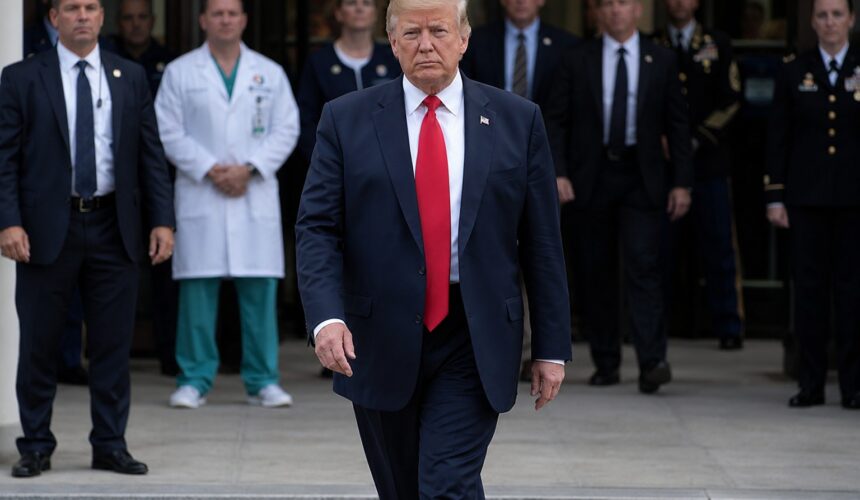
A newly released medical report on President Donald Trump is drawing scrutiny from physicians across the country – not for what it claims, but for what they say it leaves out. The memo, issued after Trump’s third visit to Walter Reed National Military Medical Center in just over a year, describes the president as being in excellent health. Several doctors who reviewed the document say it is missing the kind of clinical detail that would normally support that conclusion.
Why The Report Is Drawing Attention
Presidential medical reports occupy an unusual place in American public life. There is no law requiring a sitting president to disclose detailed health information, yet voters and the press have come to expect a baseline of transparency, especially as the men holding the office have grown older. When a report is released, the specifics matter – and physicians say this one is unusually thin on the numbers that doctors rely on to interpret results.
The visit marked Trump’s third trip to Walter Reed in roughly a year, a frequency that itself prompted questions. The White House has consistently described the visits as routine, but the latest summary has reignited a long-running debate over how much detail a president owes the public about his health.
The Missing Numbers
Cardiologists who examined the report focused on the heart workup. The memo references a coronary CT angiography, an echocardiogram, and an AI-enhanced electrocardiogram – all standard, sophisticated tests. But it omits the figures those tests typically produce. There is no coronary calcium score, no breakdown of arterial plaque, and no CAD-RADS classification, the standard scale doctors use to gauge the extent of coronary artery disease.
The medication list raised similar concerns. The report named three drugs, including aspirin, but did not list a single dosage. To a physician, a medication without a dose is incomplete information – it tells you what is being treated but not how aggressively.
Doctors also noted an omission of a different kind. A neck rash that appeared on the president earlier this year, and which had prompted a separate White House memo at the time, goes entirely unmentioned in the new report. Earlier physicals had detailed minor skin findings such as sun damage and benign lesions, making the silence on the rash stand out.
The White House Response
The White House has pushed back on the criticism, characterizing the report as a normal summary. Officials said it is standard practice to provide incomplete medication lists that are, in their words, abbreviated for readability and relevance. In other words, the missing details are a matter of editing, not concealment.
Not everyone is convinced. Dr. Jonathan Reiner, a cardiologist and professor of medicine at George Washington University, publicly disputed the explanation, arguing that the official account simply does not hold up. His objection captures the core of the dispute: is this a routine summary, or a report that quietly leaves out information that would let independent doctors draw their own conclusions?
What This Means For Americans
The health of a sitting president is a matter of national interest, not idle curiosity. Voters weigh it at the ballot box, markets react to it, and the line of succession depends on it. When a medical report raises more questions than it answers, the resulting uncertainty becomes a political story in its own right – regardless of whether the underlying health picture is actually a concern.
The debate now is less about whether the president is healthy and more about transparency: should a sitting president’s medical report include every clinical detail, or is a summary enough? That question is likely to follow this White House – and future ones – for some time.
Stay informed on the stories that matter most. Follow Here’s What Happened on Facebook and bookmark hereswhathappened.news for breaking news and analysis.