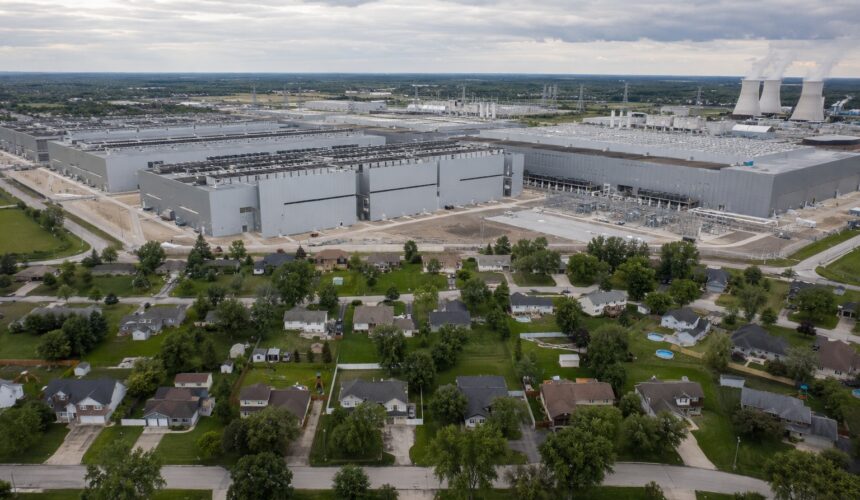
Most Americans want the benefits of artificial intelligence. What they do not want is the enormous physical machinery that powers it sitting next to their homes. A new Gallup poll has found that roughly seven in ten U.S. adults oppose having an AI data center built in their local area, a striking show of resistance as the technology industry races to construct the infrastructure behind the AI boom.
The survey, which reached 1,000 adults across all 50 states in March, found that 48 percent of respondents strongly oppose a data center being built nearby. Only 27 percent said they would support one in their community. The numbers paint a clear picture of a country that has embraced AI tools in daily life but remains deeply wary of the sprawling industrial facilities that make them possible.
Why Americans Are Pushing Back
The opposition is not abstract. When asked why they object, respondents pointed to concrete, local concerns. Chief among them is the staggering amount of resources these facilities require. Modern data centers consume vast quantities of electricity to run thousands of servers, and even more water to keep that hardware from overheating. In some regions, a single large facility can use as much power as a small city and millions of gallons of water a day.
Beyond resource consumption, residents raised concerns about pollution, including noise from cooling systems running around the clock, and the strain that a major facility places on local power grids. Others worried about increased traffic during construction and operation, falling property values, and the simple question of whether industrial development belongs near residential neighborhoods at all. For many, it comes down to quality of life: the fear that a quiet community could be transformed almost overnight by a massive, humming complex on the other side of the fence.
A Rare Issue That Crosses Party Lines
What makes the Gallup findings especially notable is that the resistance is not confined to one side of the political spectrum. In an era when nearly every issue splits sharply along partisan lines, opposition to nearby data centers unites Americans across the board. According to the poll, 56 percent of Democrats, 48 percent of independents, and 39 percent of Republicans all expressed a “not in my backyard” attitude toward the facilities.
That broad agreement suggests the concern is rooted less in politics and more in shared, practical worries about land, water, power, and community character. It is the kind of local issue that can bring together neighbors who otherwise agree on very little.
The Case for the Centers
Supporters are not silent. Those in favor of building data centers locally point primarily to economics. Construction projects of this scale create jobs, and the facilities themselves bring tax revenue that can fund schools, roads, and public services. For some communities, particularly those that have lost manufacturing or other industry, a major tech investment can look like a lifeline. Many backers cite the promise of new job opportunities as the single biggest reason to welcome a facility.
The tension between those economic arguments and residents’ quality-of-life concerns is now playing out in town halls and zoning meetings across the country. As tech giants pour billions into the infrastructure needed to train and run AI models, more and more communities are being asked to host the result.
What This Means for Americans
The AI revolution is often described in terms of software and chatbots, but it has a very real physical footprint, and that footprint is expanding fast. As demand for computing power grows, the number of data centers will only increase, which means the debate Gallup has captured is likely to land in more and more neighborhoods. For ordinary Americans, the question is no longer theoretical: it is whether the next big facility goes up down the road from their own front door, and whether the jobs and tax dollars are worth the water, power, and noise.
Stay informed on the stories that matter most. Follow Here’s What Happened on Facebook and bookmark hereswhathappened.news for breaking news and analysis.